
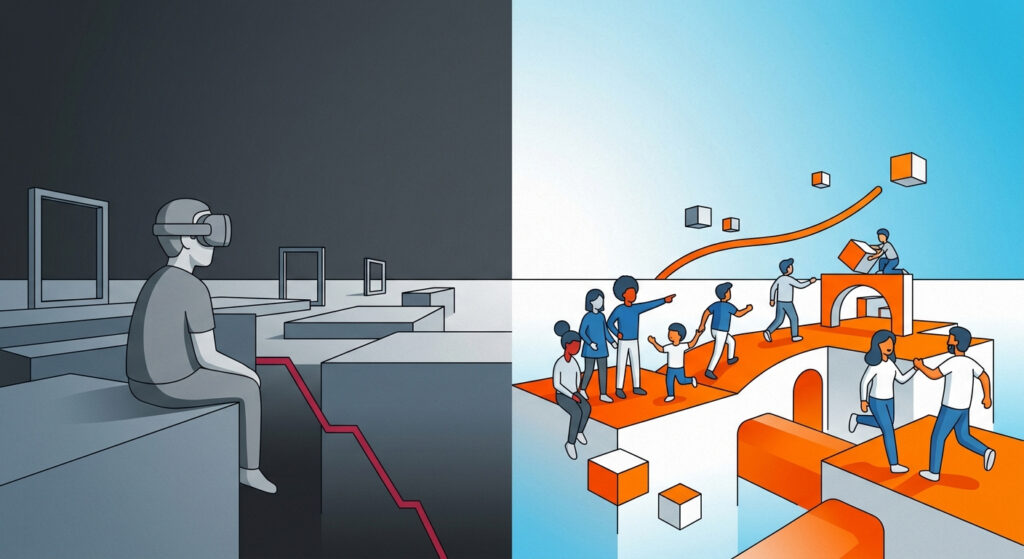
The digital revolution didn’t die—it just fired its most famous self-appointed CEO.
For the last two years, mainstream media has been obsessed with one narrative: “The Metaverse is Dead.” They point to Meta’s staggering $50 billion loss and empty virtual lobbies as proof of a failed tech dream. But they are looking in the wrong place.
The Metaverse isn’t a corporate product you buy from a billionaire. It’s an ecosystem. While Mark Zuckerberg was trying to force us into sterile virtual offices using bulky headsets, a quiet revolution was happening on smartphones and PCs. Zuckerberg’s Metaverse failed because it was built on vanity; the real Metaverse is thriving because it’s built on community.
The Tale of Two Realities
Meta tried to build a “walled garden”—a closed destination where they control the data, the rules, and the physics. In contrast, Roblox built an engine for human creativity. The results speak for themselves:
- Capital Burn: Meta burned over $50 Billion in losses, while Roblox maintains profitable growth.
- Active Users: While Meta’s Horizon Worlds struggles to keep 200k users, Roblox attracts over 70 Million daily.
- Creator Economy: Meta’s payouts are gatekept and corporate-led. Roblox paid out over $700M to independent creators in 2023 alone.
- Accessibility: Meta requires a $500+ VR headset. Roblox runs on any smartphone in the world.
A Set of Tools, Not a Destination
We need to stop thinking of the Metaverse as a single “app.” It is the spatial evolution of the internet. It is a collection of tools, protocols, and social layers that allow us to exist digitally.
Roblox is winning because it understood this: it provided the bricks and let the users build the house. Thousands of developers on Roblox are now millionaires, not because of corporate subsidies, but because they created value for a global audience.
The 10 Fundamentals of the True Metaverse
To understand why the “corporate Metaverse” failed, we must return to the structural foundations defined by pioneers like Tony Parisi:
- Decentralization: No single company should own the Metaverse.
- Spatial Computing: Moving from flat pages to immersive 3D space.
- The Creator Economy: Value must flow to the users who build the world.
- Discovery: A seamless way to find and jump between experiences.
- Interoperability: Your digital identity and assets must be portable.
- Immersion: Presence is a psychological state, not a hardware requirement.
- Persistence: The digital world keeps moving even when you are offline.
- Real-time: Synchronous interaction is the heartbeat of social tech.
- Identity: A consistent “you” across the digital frontier.
- Security & Trust: The fundamental layer for any digital society.
Conclusion
Mark Zuckerberg didn’t build the future; he built a gated community no one wanted to move into. The Metaverse isn’t dead—it’s just evolving beyond the control of Big Tech. The future is open, chaotic, and built by the many, not the few.
Do you think Meta can ever pivot, or is the “Zuck-verse” officially over? Share your thoughts below.
Sugestões de Tags para o WordPress:Metaverse, Roblox, Mark Zuckerberg, Tech Industry, Creator Economy, Web3, Tony Parisi.